
Contact Us
Phone:+86 13961837633
Tel:+86 0510-81152329 +86 13961837633
Fax:+86 0510-81152329
E-mail:464788795@qq.com
Add:A31, No. 48-11 Renmin West Road, Hudai Town, Binhu District, Wuxi, Jiangsu Province, China
- Open Crossflow vs. Closed Counterflow Towers[ 2026-10-29 ]
- Open crossflow cooling towers and closed counterflow cooling towers are two of the most widely used heat dissipation devices in industrial refrigeration, central air conditioning, air separation and precision equipment cooling systems. With different heat transfer principles and structural designs, they differ fundamentally in operating energy efficiency, service life, adaptability to working conditions and protection capability for downstream equipment. Drawing on more than ten years of cooling tower engineering experience, field operation data from multiple indus
- FRP Cooling Tower vs Stainless Steel Cooling Tower: Advantag[ 2026-10-27 ]
- Each material suits different application scenarios. The selection mainly depends on operating environment and budget. FRP Cooling Tower Pros: Lightweight, low load requirement for the foundation, and lower upfront cost. FRP offers adequate resistance to general corrosion, suitable for standard industrial circulating water and HVAC cooling systems. Cons: Surface resin tends to age, fade and chalk under prolonged sunlight exposure. Its service life is reduced in coastal salt-laden or chemically corrosive environments. Stainless Steel Cooling Tower Pros: High structu
- Special Requirements for Cooling Tower Selection under High-[ 2026-10-27 ]
- Cooling towers for high-temperature applications cannot be selected using standard specifications for ambient-temperature service. Selection needs separate evaluation of fill media, tower shell, motor and thermal load calculation. High-temperature resistant fill media Standard PVC fill media tends to soften, deform, bond or collapse under elevated water temperatures, resulting in loss of heat transfer capacity. For high-temperature conditions, fill media with a higher temperature rating shall be adopted. Verify that the maximum allowable inlet water temperature of
- What Are the Differences Between Closed-Circuit and Open-Cir[ 2026-10-23 ]
- The primary distinction lies in whether the cooling medium comes into direct contact with air, which leads to differences in water quality, maintenance requirements and capital cost. Open-Circuit Cooling Towers Circulating water is sprayed directly onto fill media and makes full contact with air for evaporative heat dissipation. They feature a simple structure, low initial cost and favorable heat transfer efficiency. On the downside, since water is exposed to ambient air, contaminants and algae can easily build up. Scaling occurs rapidly on fill and piping, requiri
- Counterflow vs Crossflow Cooling Towers: How to Choose?[ 2026-10-22 ]
- Counterflow and crossflow cooling towers do not have absolute advantages or disadvantages. The selection depends heavily on site operating conditions. Given the different directions of airflow and water flow, they feature distinct performance characteristics. Features of Counterflow Cooling Towers Air flows upward while water falls downward, creating countercurrent contact between air and water. This delivers superior heat transfer efficiency and a smaller footprint for the same cooling duty. Counterflow towers are suitable for industrial projects and applications
- Key Parameters Required for Cooling Tower Selection[ 2026-10-21 ]
- Cooling tower selection cannot be based on water flow alone. Suppliers require clear operating conditions to recommend a properly sized model. The main parameters to be provided are listed below. Water Flow and Temperatures Circulating water flow is the fundamental parameter. Inlet water temperature and outlet water temperature (i.e., the required temperature drop) must also be specified. The temperature difference directly determines the heat exchange area and tower size for selection. Wet-Bulb Temperature The local summer wet-bulb temperature is a critical basis
- Cooling tower outer box sheet metal material[ 2025-06-10 ]
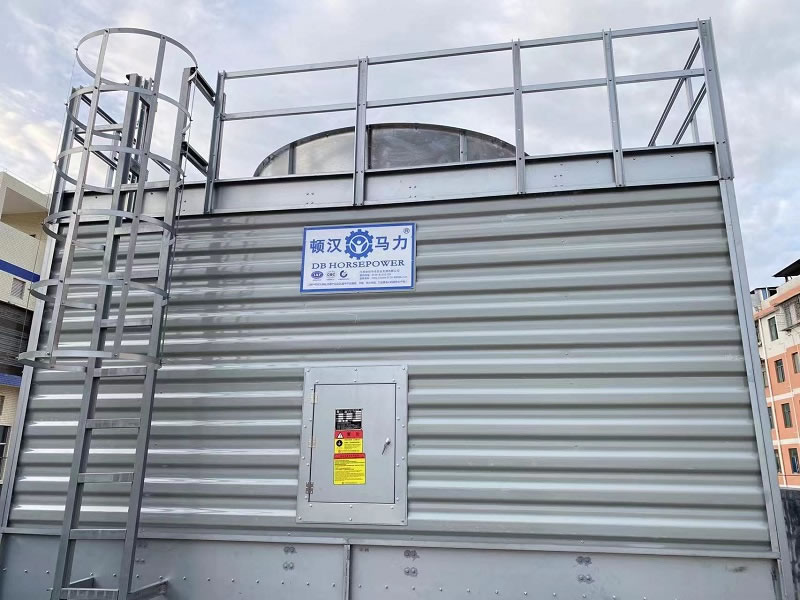
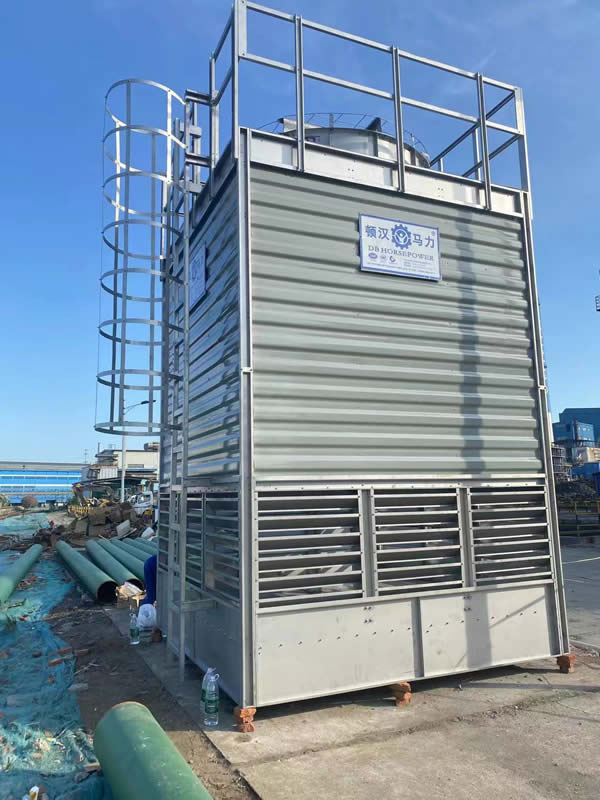
- The shell of a closed cooling tower is generally made of high-quality magnesium aluminum zinc plated sheet metal produced in South Korea (imported) or high-quality 304 stainless steel sheet metal produced in Pangang and Baosteel in China; Good anti-corrosion performance, Ensure that it does not rust for 10-20 years. The CNC machine tool is assembled without welding seams after cutting, punching, and folding, with a beautiful appearance and precise dimensions.
- 304 stainless steel tube heat exchanger[ 2025-06-10 ]
- Stainless steel surface cooler (cooling coil) a. The cooling coil should be made of SS304L stainless steel U-shaped tubes with a diameter of 19mm and a delta of 1mm. The water flow direction on the water side of each heat exchange tube should form a reverse flow of air and water with the direction of air flow outside the tube. b. The support frame of the cooling coil should be welded with SS304L stainless steel angle iron, and its processing and welding process should meet the requirements of relevant national metal processing and welding standards. The surface cle